The Definitive Guide to Full-Height Porcelain Feature Walls
Large-format porcelain slabs are redefining feature-wall architecture across New York City, Long Island, and New Jersey. Moving far beyond small-format tile, high-end developers, architects, and interior designers are specifying continuous porcelain panels to build the detail that now signals a luxury interior: the uninterrupted vertical plane. A fireplace surround that runs unbroken to a vaulted ridge, a wine wall that reads as a single sheet of stone, a bath enclosure with no visible grid. This delivers the look of bookmatched natural stone without the weight, the lot-matching risk, or the maintenance liabilities of real marble.
As a premier regional importer and stockist handling large-format material daily, the Porcelain Source team provides this technical resource guide. Below, we break down the engineering metrics, the dead-load and substrate science, official architectural sizing charts, the leading Italian brands we hold in stock, and the ANSI installation parameters you must know when planning a full-height porcelain feature wall.
1. Real-World Case Study: A 22-Foot Feature Wall Integration
(Below is a two-story great room feature wall supplied by Porcelain Source and published in NJ HOME.)

Photography by Mike Aghachi, courtesy NJ HOME.
Material Featured: Porcelain Source Blue De Savoia (100% Made in Italy)
Dimensions Applied: 120" x 60" Grand Panels (6mm Structural Thickness), approximately 5 slabs
Location: Private Luxury Residence, Franklin Lakes, New Jersey
Featured In: NJ HOME, June/July 2024
Design & Fabrication: Z+ Architects and Z+ Interiors (Allendale, NJ); Signature Home Builders (Englewood Cliffs, NJ); material supplied by Porcelain Source
Design Architecture & Execution Analysis: The owners set out to build a Hamptons-style home in North Jersey and ran into a sourcing problem familiar to any designer working this aesthetic: the palette is easy to describe and difficult to buy. The homeowner has said the style simply "was not common in New Jersey," and that the team had to get creative to find the materials the design demanded. Porcelain Source was the solution.
The architectural center of the 12,500-square-foot residence is a two-story great room with a vaulted white-oak-beamed ceiling and a wall of floor-to-ceiling glass. The rectangular fireplace within it is encased in a 22-foot-high wall of continuous Blue De Savoia porcelain, carried floor to vaulted ceiling in the grand 120" x 60" format so the vein maps as a single plane with no small-format grid to interrupt it. Porcelain then continues throughout the residence, as kitchen counters and a veined backsplash, as flooring in the informal dining area, in a custom wine wall, and through the bathrooms, so one product family covers surfaces that would otherwise require four different materials with four different maintenance regimes.
2. The Structural Science: Why Porcelain Outperforms Marble and Quartz
A Hamptons-style palette depends on consistency: whites that stay white, greys with quiet and repeatable veining, and the same visual carried across large planes in several rooms. Natural marble resists all three requirements, which is exactly why this project was hard to source in stone.
Lot variation. Two slabs cut from different blocks of the same named marble can differ substantially in ground tone and vein density. Specifying a whole-house palette from a single sample is a gamble.
Yardage and weight. A 22-foot feature wall plus a kitchen and a bath in matched material requires sequential slabs from one block, inventory that may not exist when the schedule needs it, and a marble slab weighs far more than its porcelain equivalent.
Moisture and staining. Airborne salt and standing moisture penetrate porous stone, recrystallize within the pore structure, and spall or track the surface over time. A topical sealer does not resolve this permanently.
Premium Italian large-format slabs are manufactured using advanced continuous roller-compaction technology. Highly refined porcelain clays and mineral oxides are compacted under immense mechanical force and vitrified in a kiln above 2,200°F. This eliminates internal air pockets and creates a dense body with a water absorption rate below 0.1%, well outperforming the ANSI vitreous threshold of 0.5%. The visual is applied digitally and reproduced consistently across an entire production lot, so a designer can specify a feature wall, a countertop, and a bath from one color profile with no block-matching risk.
The Feature-Wall Material Performance Matrix
| Performance Metric | Italian Porcelain Slabs | Natural Marble | Engineered Quartz |
|---|---|---|---|
| Water Absorption (ASTM C373) | Below 0.1% (Impermeable) | 0.20% to 0.60% (Porous) | ≈ 0.5%, resin-bound |
| Stain & Acid Resistance | Class A (ASTM C650) | Low, etches on contact | Resin binder degrades |
| Structural Sealing | Never required | Every 6 to 12 months | Not applicable, interior only |
| Color Fastness | Inert, no fade | Iron deposits oxidize; yellowing risk | Polymer resin yellows and warps |
| UV & Exterior Stability | Fully stable, frost resistant (ASTM C1026) | Variable by stone | Warranty voided by most makers |
The quartz column is the one worth explaining to clients, because engineered quartz is often the incumbent proposal. Quartz is roughly 90% mineral held in a petroleum-derived polymer resin: the mineral is durable, but the resin is not UV-stable and is not rated for exterior use. Porcelain is the only surface of the three that can carry the same visual from an interior feature wall through to an outdoor kitchen or pool deck.
Dead load
The weight advantage is the reason full-height porcelain is buildable at all on framed construction.
| Material and thickness | Approx. weight per sq ft | 120" x 60" panel (50 sq ft) |
|---|---|---|
| 6mm porcelain | ≈ 3.0 lb | ≈ 150 lb |
| 12mm porcelain | ≈ 6.0 lb | ≈ 295 lb |
| 20mm porcelain | ≈ 9.8 lb | ≈ 490 lb |
| 2cm marble or granite | ≈ 11 to 13 lb | n/a at this format |
| 3cm marble or granite | ≈ 16 to 19 lb | n/a at this format |
On a 22-foot by 12-foot elevation, roughly 264 square feet, that difference is approximately 800 lb in 6mm porcelain against roughly 4,500 lb in 3cm natural stone. The first is a framing detail. The second is a structural revision. Nominal figures; confirm against the manufacturer dossier before use in a structural submittal.
Support during cure and mechanical backup
Above roughly eight feet, panels creep under their own weight while the mortar is green, so temporary mechanical support, ledger battens carrying each course, is required until the bed develops strength. Manufacturer instructions and local code may call for permanent mechanical backup on tall runs, with undercut anchors or a rail system carrying the dead load and the adhesive acting as a stabilizer rather than the sole means of support.
Handling at height
A 120" x 60" panel in 6mm weighs roughly 150 lb and is unforgiving of point loads. It requires a lifting frame, a crew of three to five, and continuous multi-point support through transport, staging, and setting. An unsupported large panel will fracture under its own weight before it reaches the wall. This is the single most common reason a general tile contractor should not be handed a full-height slab scope without large-format experience.
Seam strategy
On a stacked vertical run the horizontal joints are the design decision. Three approaches work: align the joint to an architectural datum such as a mantel line or ceiling break so it reads as intentional; sequence the panels so the eye reads a continuous stone rather than a seam; or suppress the joint with minimum width and a color-matched grout or mitered detail where the visual has little directional veining. Movement joints follow TCNA EJ171, with perimeter joints at every restraining surface and at all changes of plane, because seasonal movement on a two-story framed wall will otherwise find the panel as the assembly’s weakest point.
4. Advanced Applications & Integrated Features
Fireplace and full-height feature walls
Porcelain is non-combustible, which removes the clearance-to-combustibles question that governs wood and composite surrounds. Detailing still has to address the thermal gradient at the firebox opening and the backing assembly behind it.
Wine walls and mechanically drilled features
The Franklin Lakes residence includes a custom glass and black-metal wine wall in which 120" x 60" Onice Bianco porcelain slabs are drilled and fitted with pegs that hold the bottles in suspension. Drilling porcelain for load-bearing hardware is a fabrication discipline in its own right:
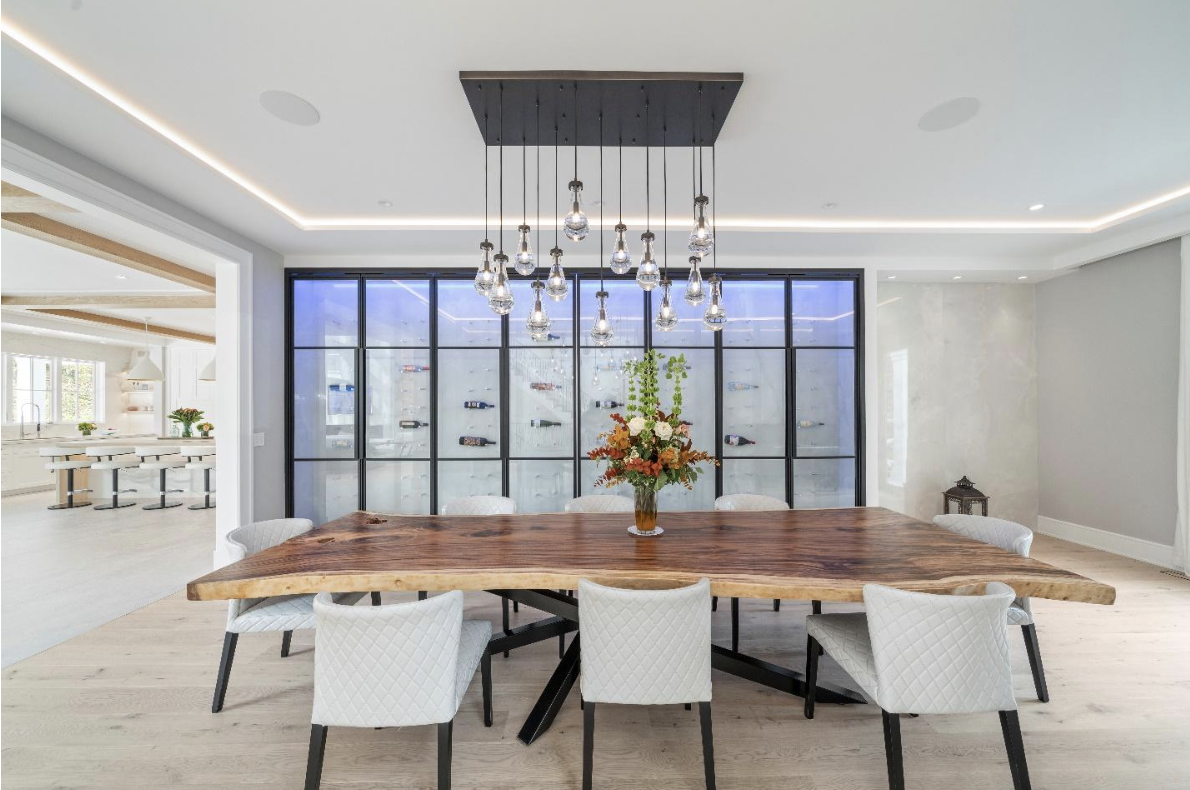
The dining room wine wall: 120" x 60" Onice Bianco slabs drilled for suspended bottle pegs.
Continuous water-cooled diamond core drilling only. Percussion or hammer mode will shatter the panel.
Minimum edge distance must be observed on every penetration.
Chemical injection anchors over mechanical expansion anchors. Expansion anchors induce radial splitting stress in a vitrified body; injected resin anchors distribute the load along the bore.
Resolve the moment into the backing, not the face. A full 750ml bottle is roughly 3 lb on a peg cantilevered four to five inches. Anchor the peg into structural backing behind the slab and treat the slab as a pass-through, so the porcelain carries no bending load.
Countertops, backsplash and floor continuity
The kitchen uses SapienStone White Calacatta 12mm porcelain counters and carries the same material across the backsplash. Porcelain then continues into the kitchen and adjacent dining floor in 120" x 60" Blue De Savoia. Continuity of this kind depends on specifying from appropriate collections and reserving matched lots across all scopes at order stage, a coordination step that happens in the Porcelain Source gallery before fabrication, not during.

White Calacatta counters on the waterfall island, with 120" x 60" Blue De Savoia across the kitchen and dining floor.

SapienStone White Calacatta 12mm counters and a veined backsplash, matched from a single collection.
5. Official Porcelain Source Sizing & Availability Matrix
Architects and contractors can specify directly from our verified stock program. Detailed dimensions across all collections are nominal.
6MM Thickness Program (Vertical Cladding & Feature Walls)
120" x 60", the ultimate grand format for seamless, floor-to-ceiling single-panel vertical runs.
60" x 60", for continuous flooring transitions and large-grid vertical layouts.
60" x 30", for horizontal banding, tub surrounds, and mid-size wall accents.
48" x 48", square format optimized for standard floor footprints.
30" x 30" & 15" x 30", coordinate sizes for niches, benches, and geometric details.
8MM Thickness Program (Polished & Natural Finishes)
24" x 48", the trade standard for heavy-traffic interior floors.
24" x 24", durable square-cut format.
48" x 48", larger and more seamless square format.
12MM & 20MM Thickness Programs (Fabrication & Exterior)
64" x 128", polished, natural, and textured finishes in 12mm and 20mm.
63" x 126", polished and natural finishes including matte, textured, and cashmere in 12mm and 20mm.
60" x 129", polished and natural finishes in 12mm.
6. Hand-Picked Brands in Local Stock
Rather than dealing with standard 12-week overseas production delays or complex customs logistics, Porcelain Source maintains a 100,000 square foot regional warehouse in Roseland, NJ, fully stocked with ready-to-ship lots from the world’s leading brands. The Blue De Savoia and Onice Bianco used in the Franklin Lakes residence, and the SapienStone White Calacatta counters, were all specified from this in-stock program.
Laminam: the world pioneer in ultra-thin, structurally flexible large-format architectural slabs, ideal for lightweight vertical cladding.
Fiandre & Iris Maximum: celebrated for hyper-realistic, deep-veined bookmatched marble replications, the look behind grand feature walls.
Florim Stone & SapienStone: heavy-duty surfaces ideal for custom-fabricated integrated counters, vanities, and matching thresholds.
ABK Stone & Ariostea: contemporary, texture-driven stone and concrete visuals for modern, minimalist designs.
7. Professional Installation Framework
Managing large-format panels at full height requires strict adherence to ANSI A108.19 for interior installations of gauged porcelain tile panels and slabs. For a successful, lifetime feature-wall installation, ensure your crew follows these protocols:
Substrate Flatness. The wall substrate must be verified flat to within 1/8" over a 10-foot run (and 1/16" over a 2-foot run). At full height, deviation cannot be built out in the mortar bed; any bowing in the framing creates hollow points behind the slab and risks mechanical fractures under point loads. The full elevation should be laser-surveyed and the framing shimmed or furred to plane before material arrives.
Double-Bedding Mortar Application. Mortar must be combed in straight, parallel lines on both the substrate and the back of the panel using a large-format notched trowel, with ridges parallel to the short side, then the panel worked back and forth to collapse them. Swirling or cross-hatching traps air pockets and violates the 95% minimum mortar coverage required for this application.
Movement Joints. Follow TCNA EJ171: perimeter joints at every restraining surface and at all changes of plane. On a two-story framed wall this is not optional, since a rigidly grouted perimeter guarantees the panel becomes the assembly’s failure point under seasonal movement.
Stress Distribution on Cutouts. All penetrations must use continuous-cooling diamond core bits. Square 90-degree internal corners are forbidden because they act as stress concentration points; pre-drill all internal corners to a minimum smooth radius of 5mm on walls (and 10mm on horizontal surfaces) to distribute loads safely.
Bring Your Bathroom Selection Into Focus
Porcelain can look very different at full scale than it does on a screen or small sample. Before finalizing your bathroom material selection, see the movement, finish, and bookmatched sequence in person—or continue your selection with our Trade Tools.
See the Material at Full Scale
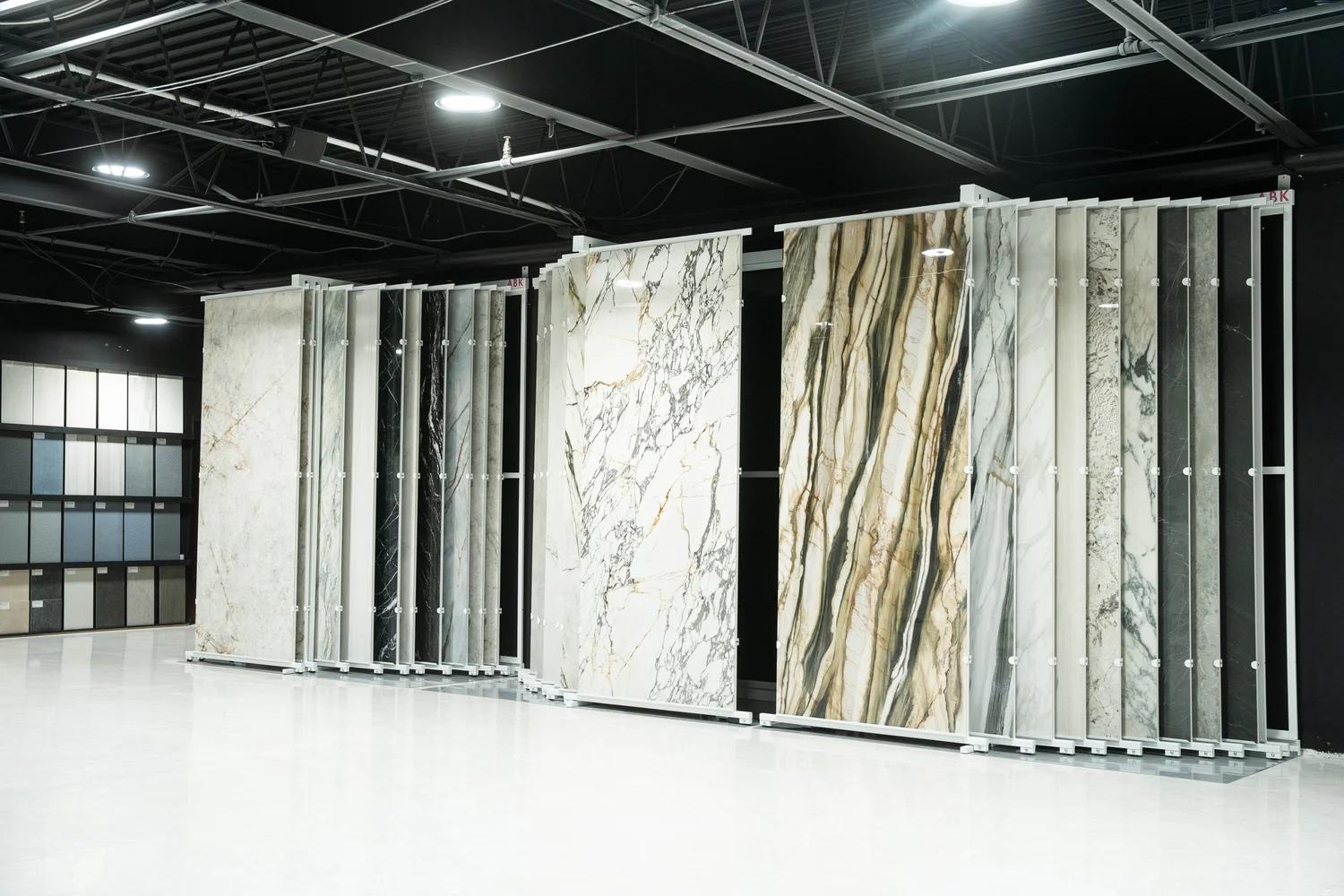
View full slabs, sequential bookmatched sets, finishes, and edge details in person to understand how the material actually reads across a space.
Specify with Confidence
Access size ranges, sample requests, and project resources designed to help you evaluate and specify porcelain slabs with confidence.